Land of Enchantment Clean Cities and Communities Update
It may have been a while since you heard from the Land of Enchantment Clean Cities Coalition. There’s a reason for that.
In early 2025, Clean Cities Coalitions across the United States were defunded by the Department of Government Efficiency (DOGE), after being funded annually since 1993. Fortunately, we received news this spring that the Clean Cities Coalitions were refunded for Fiscal Year 2026 in a bipartisan effort from Congress. We are happy to once again focus on our work in New Mexico on all alternative fuel technologies to help reduce transportation emissions and improve environmental health throughout our state.
As we relaunch the coalition this summer, our longtime Executive Director, Colin Messer, will eventually transfer the director’s duties to his son, Mateo Messer, who has been involved in the Coalition’s work for several years. Mateo brings deep knowledge of New Mexico communities and clean fuel technologies, along with extensive GIS and mapping skills. Also continuing to work with the Coalition will be Amy Miller from AMM Consulting out of Albuquerque.
For more information on the DOE Clean Cities program, visit https://cleancities.energy.gov/
As New Mexico's DOE-designated coalition, Land of Enchantment Clean Cities is back in business and ready to assist fleets, local governments, businesses, utilities, schools, tribal communities, and nonprofit organizations with transportation and energy initiatives. Whether you are exploring alternative fuels, fleet electrification, charging infrastructure, grant opportunities, emissions reduction strategies, or collaborative projects, we welcome the opportunity to partner with you.
If your organization could benefit from technical assistance, stakeholder connections, project support, or partnership opportunities, please reach out. We look forward to working together to advance clean, affordable, and secure transportation solutions across New Mexico.
Thank you for your continued support of Land of Enchantment Clean Cities Coalition.
New Albuquerque Sunport Wait Lot Now Offers Fast Charging
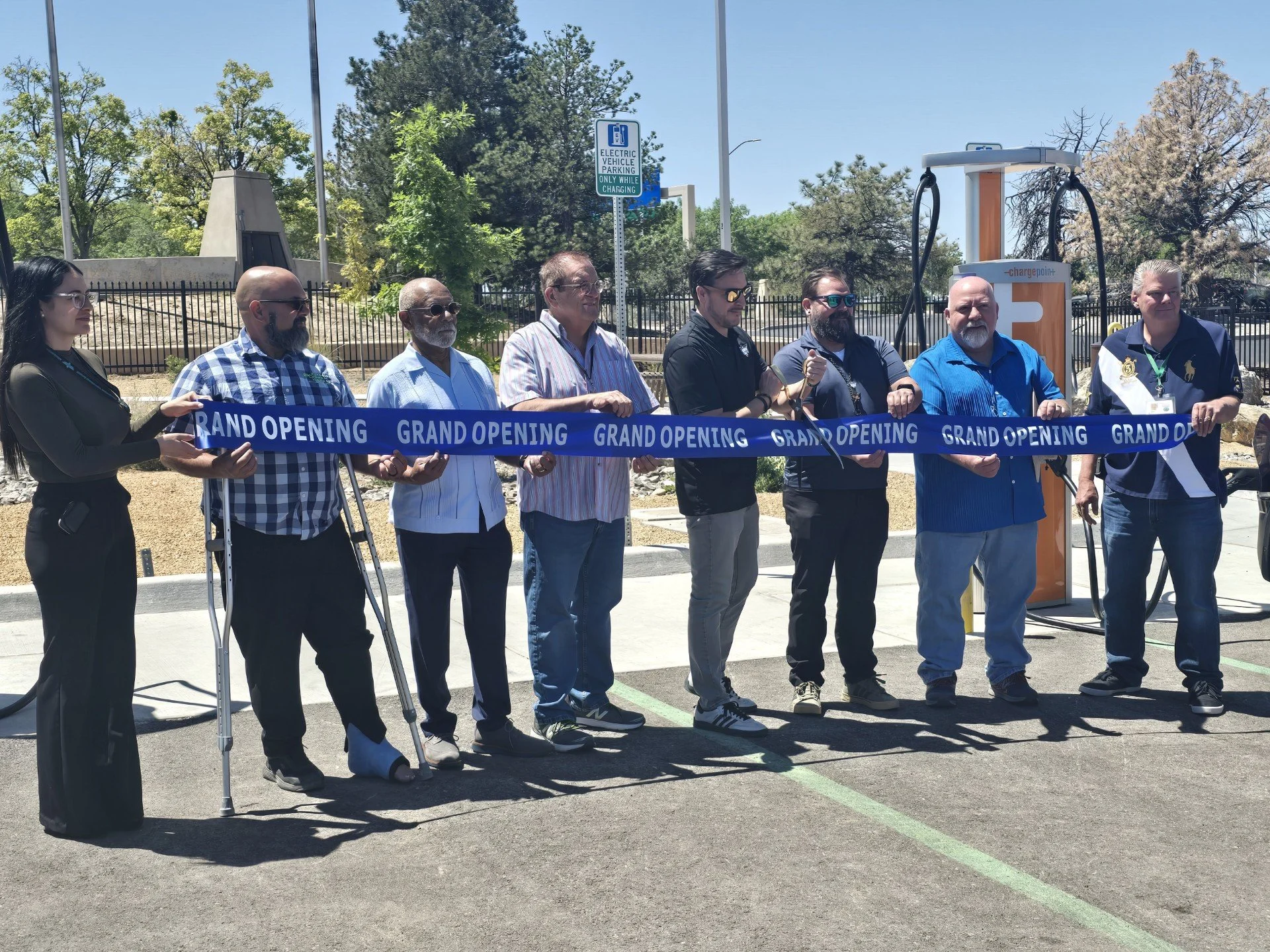
The Albuquerque International Sunport recently held a ribbon-cutting for the new public electric vehicle charging stations located at "The Holding Pattern" cellphone waiting lot, situated along Sunport Boulevard.
Two Level 3 DC fast chargers are now available to electric vehicles waiting in the lot for incoming flights.
For more information on the event and the chargers, visit ABQ Sunport.
Affordability Mobility Carshare Project Expands to Las Cruces
The Affordability Mobility Carshare Project, an electric vehicle carshare pilot program, currently has four sites in New Mexico and more on the way. Las Cruces kicked off a site this year with Chevy Bolt vehicles, and an accompanying charging station are now available at the following location in downtown Las Cruces at S Main St Parking Lot, 307 S Main St, Las Cruces, NM 88001
The Albuquerque site is still in operation PAH!
📍Hiland Plaza, 5000 Central Ave. SE, Albuquerque, NM 87108
The two Santa Fe stations are still in place but will most likely be moved to other sites.
The current locations are:
📍8 Las Lomas Dr, Santa Fe, NM 87508
📍52 Camino de Jacobo, Santa Fe, NM 87507
Anyone is eligible to apply for the Carshare program. Before renting a car, interested users need to download the MDO Carshare App and register for a GoForth car-share account by entering their driver’s license and debit or credit card. Applicants wait to receive approval and are then required to attend a brief onboarding call. The rental fees cover specific car-sharing insurance, so personal car insurance isn’t necessary. Users can reserve cars and unlock the vehicles using the MDO CarShare App on the App Store or Google Play.
For more information, visit Forth Mobility.
State of New Mexico Issues Climate Plan with Transportation Goals
In December of 2025, the State of New Mexico issued a Climate Plan. The New Mexico Climate Action Plan provides a roadmap to reduce greenhouse gas emissions from key sectors, including transportation, electricity, buildings, waste and materials, and agriculture, forests, and wilderness.
Transportation strategies start on page 59 of the report, found on the Climate Action Plan and include the following key areas:
Expanding and improving public transit
Expanding and improving access and safety for active transportation
Supporting transit-oriented development by reassessing land use
Reducing employee vehicle miles traveled
Expanding zero-emission infrastructure
Future of Transportation Forum Held in Sunland Park to Explore Transportation Emissions Reduction Options
The State of New Mexico Energy, Minerals and Natural Resources Department, New Mexico State University Arrowhead Center, and the New Mexico State University School of Engineering hosted a policy forum on March 11 in Sunland Park, NM. This forum was part of a larger convening across the state to discuss workshop policy solutions for New Mexico’s energy transition and to provide information to inform a final strategy report with actionable policy solutions to chart a pathway for New Mexico’s comprehensive energy transition.
Speakers at the Sunland Park forum highlighted the New Mexico Clean Transportation Fuel Standard and the Southern New Mexico Central Transit District's clean vehicle efforts. Attendees provided a variety of suggestions for policies and programs to reduce transportation-related emissions in New Mexico.
To see speaker information and attendee policy recommendations, visit Arrowhead Center NMSU
Save the Date
September 18, 2026 | New Mexico State Fair Science and Technology
The Land of Enchantment Clean Cities Coalition will exhibit various alternative-fuel vehicles on Main Street.
NMED Clean Transportation Fuel Program
The New Mexico Clean Transportation Fuel Program establishes a statewide carbon intensity standard for transportation fuel that decreases annually. The program creates a market where companies with fuel exceeding the standard must acquire credits, while those with low-carbon fuel generate credits they can sell or trade.
This system is designed to incentivize a reduction in the overall carbon footprint of transportation fuel and decrease climate pollution in New Mexico.